Apple's Hidden AI Library Architecture
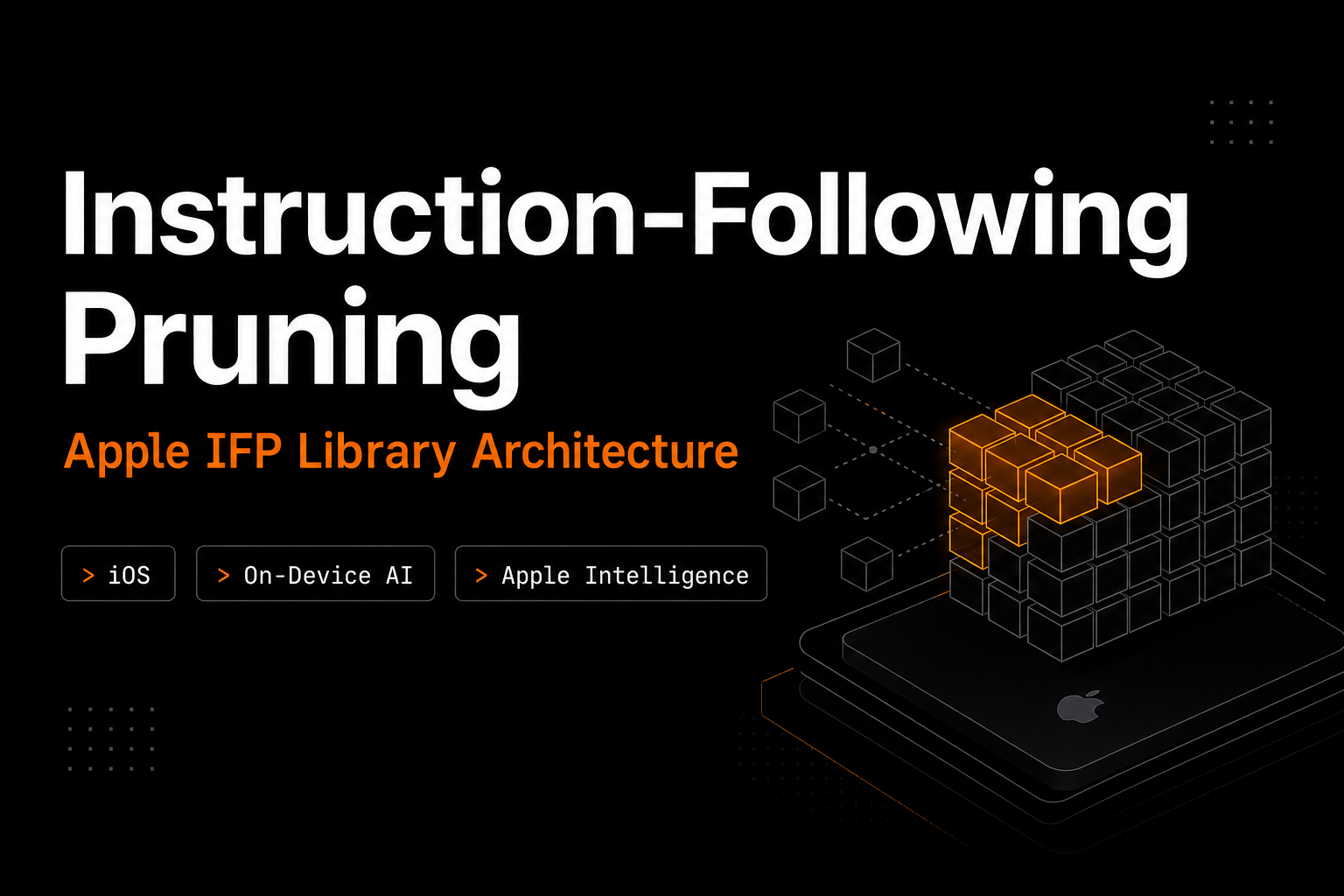
Apple uses Instruction-Following Pruning to run 20-billion parameter foundation models on device. AFM 3 Core Advanced activates only 1 to 4 billion parameters per prompt from NAND flash.
Watch the original short →Apple uses Instruction-Following Pruning (IFP) to run 20-billion-parameter foundation models locally on Apple Silicon. The full model lives in NAND flash; a routing block reads each instruction and loads only the expert paths the prompt needs into DRAM. Frontier-scale intelligence without running the entire network on every request. As an engineer building zero-cloud iOS software, this instruction-aware routing is the foundation for running deep reasoning locally without cloud offload.
A dense language model activates its full parameter graph for every token. Load a 20-billion-parameter model and every matrix multiplication fires whether the user asks for a coding task or a one-line summary. Running the full network for basic text edits drains power and pushes thermals. To ship models at this scale on device, Apple abandoned static full-network activation.
The Static Compute Bottleneck
Historically, pruning was a static training decision. Engineers identified weak connections and removed them permanently to shrink the model.
Static pruning caps capability. Prune aggressively for email tasks and the network loses depth for Swift code generation. Teams chose between a capable dense model that drains the battery or a fast small model with a narrower skill range.
The Dark Library Analogy
Apple bypassed static pruning with dynamic routing. Compare the architecture to a large library with motion-activated lighting.
You do not illuminate every aisle when a reader asks one question. A sensor at the entrance reads the request and switches on lights only along the path to the relevant shelves. The rest of the building stays dark and draws no power.
IFP applies the same pattern to neural network weights.
How Instruction-Following Pruning Works in AFM 3 Core Advanced
AFM 3 Core Advanced is Apple’s 20-billion-parameter on-device model built on IFP, an Apple research technique for sparse activation.
The full weight set resides in NAND flash. Dense and standard mixture-of-experts designs keep all weights in DRAM, which caps how large an on-device model can grow. AFM 3 Core Advanced stores the library in flash and streams only the required experts into active memory.
At inference time, a lightweight dense routing block evaluates the instruction and selects which expert subsets to activate. Apple routes once per prompt, not per token, because NAND-to-DRAM bandwidth cannot support continuous expert swapping at generation speed.
Apple reports the model activates 1 to 4 billion parameters per request while the full 20-billion-parameter knowledge base remains on flash. The active footprint can resemble a 3-billion-parameter run, but the dormant weights still shape output quality.
Always-active shared experts stay loaded; input-dependent routed experts swap in only when the prompt requires them. That combination is what enables inference-time elasticity: compute scales with task difficulty instead of taxing the device at full model width every time.
The Independent Developer Advantage
When a 20-billion-parameter model scales its active footprint per prompt, application architecture changes. You get deeper on-device reasoning without recurring cloud API fees or sacrificing iOS responsiveness.
I build LocalPlan and LocalMemo on on-device Apple Foundation Models. Routing evaluates the request locally; inference runs on your silicon and your data never leaves the device.
Conclusion
Instruction-Following Pruning treats neural network activation as a context-aware variable. Route each prompt to the parameters it needs and the on-device memory ceiling moves. If you build for iOS, dynamically pruned foundation models like AFM 3 Core Advanced are the efficient deployment path.
Try LocalPlan, LocalMemo, or Kaari to see on-device AI in production. Explore the App Catalog for more on-device apps and architecture notes.
Sources: Apple Foundation Models: Third Generation · Apple Machine Learning Research · Foundation Models adapter training
Self-Test & FAQ
Click to reveal answerWhat is Instruction-Following Pruning?
How does IFP save battery life on iOS?
Why compare IFP to a dark library?

Newsletter
Join the Newsletter
Technical notes on on-device AI, generative music workflows, and building native Apple software sent directly to your inbox.
Subscribe via beehiiv. See ourPrivacy Policy.